In the throes of World War II, young men were called to serve their country overseas, leaving many companies with gaps in their workforce. Women were asked to rise to the occasion and take on the jobs traditionally performed by men, ranging from clerical to industrial labor. Women were present in the workforce, but their roles were primarily unseen. Propaganda like illustrations of “Rosie the Riveter” curated an image for modern women of the 1940s. Rosie was strong, supportive of her country, and as illustrated by J. Howard Miller, was quite a classic beauty. Who would not want to roll up their sleeves and be a Rosie? Although women stepped into essential roles, they were frequently met with judgment.
What challenges did women face working during World War II?
Around 6 million women took factory jobs during the war. They stepped up, yet in many cases were criticized for “taking jobs from men,” or lowering their statuses. Equal pay to their male counterparts was simply an unreachable dream to many women, and those who obtained it were met with obstacles such as government policies, strikes, union labor agreements, and more. Work was even harder to obtain for women of color, with many women initially barred from the workforce until activist Mary McLeod Bethune brought the issue to the president’s desk. Franklin D. Roosevelt signed Executive Order 8802 into law in 1941, banning racial discrimination in the defense industry and empowering over 1 million women of color to join defense work.
Dr Pepper Company During World War II
Like many businesses across the country, the Dr Pepper Company faced wartime labor shortages as employees left to serve in the military. At the same time, the company’s consistent marketing built a customer base accustomed to enjoying a Dr Pepper at 10, 2, and 4 each day.
As wartime sugar rationing left many soft drink companies struggling with limited supplies, Dr Pepper maintained access to the sugar it needed. Utilizing their slogan “Drink a bite to eat at 10, 2, and 4 o’clock,” Dr Pepper argued the importance of drinking the beverage at the allotted times to keep energy up on the home front, especially in factories. As the campaign helped maintain strong demand, the Dr Pepper Company also had to contend with wartime labor shortages that made keeping up with production more challenging.
How Did Women Contribute to the Dr Pepper Company During World War II?
To sustain production and distribution during the war, the Dr Pepper Company recruited wives, siblings, and other women to work in its bottling facilities. Some were hired to meet temporary wartime needs, and in some case, others continued their employment after the war.
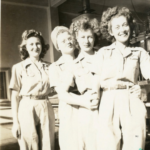
At the Fort Worth bottling facility, the women who took on positions during the war were nicknamed the Pepperettes. This month’s collection spotlight features photographs of a handful of the Pepperettes from 1944. Additionally, shown are the managers of the Fort Worth bottling plant, Rollie and J. B. Dorris, relations of Henry B. Dorris who founded the Fort Worth bottling facility in 1928 after working for over twenty years for the Waco-based Dr Pepper Company.
Featured in all of the photographs is Helen Taylor, who at eighteen years joined the Pepperettes on the Dr Pepper bottling line during the war. Her experience inside the company was monitoring the conveyor belts of Dr Pepper bottles and packing for the trucks. Helen Taylor’s daughter, Betty Brett, remembers her mother remarking about being allowed to pull a Dr Pepper bottle straight off the line whenever she felt thirsty.
Balancing family life with the new environment of a career, women like Taylor worked the same eight-hour days as their male counterparts. They even may have worn the same uniforms refitted for the female form or were issued new tailored route salesman suits. Wartime preached scrappiness, so tailoring factory clothing to fit was very likely for these women. Fabric was heavily rationed; therefore, silhouettes got tighter, skirts got shorter, and what would be considered up-cycling today would be considered “making it work” during WWII. Either way, the surprising swiftness with which women were incorporated into the workforce speaks volumes to the efficiency and aptitude of companies such as Dr Pepper in coping with wartime employment and production.
Many of the News and Views as well as the Clock Dial publications from 1942-1945 illuminate the role women played in the operation of the bottling machinery in articles titled “Womanpower”. Even during the misery of the war, however, Pepperettes and other Dr Pepper employees found time to relax.
In an article titled “Dallas and Ft. Worth Fight Air Battle” in the April 1945 issue of News and Views, Helen Taylor was a featured contestant on the quiz radio show “The Quiz of Two Cities” sponsored by Listerine toothpaste. Helen was the first-round contestant for the Fort Worth bottling team, followed by fellow Pepperette Violet Owens in the third round versus the Dallas Dr Pepper bottling team in a four-round challenge of general knowledge questions. In each round, one contestant from each team answered three questions to earn points and prize money. If the contestant answered the question correctly, the money went into their own pocket. If the contestant’s response was incorrect, the money went into a jackpot for a team-oriented bonus round called the “super-duper question”. After a nail-biting tie, the Dallas team went on to win the jackpot prize of sixty-three dollars. After the war, Pepperettes continued to work in various capacities at Dr Pepper bottling facilities; however, the nickname would not reappear until the early 1980s as a reference to a band of “I’m a Pepper” commercial dancers.
The Stories of the Pepperettes Live On
The contributions of Pepperettes and other women at the Dr Pepper Company during World War II were an important part of the company’s history. As the war changed the workforce at the Dr Pepper Company, it revealed the dedication and strength of the women who stepped forward. Their contributions helped support both the war efforts and the Dr Pepper Company during a challenging time in history. To learn more stories of the people, moments, and innovations that helped shape Dr Pepper’s legacy, plan your visit to the Dr Pepper Museum today.